
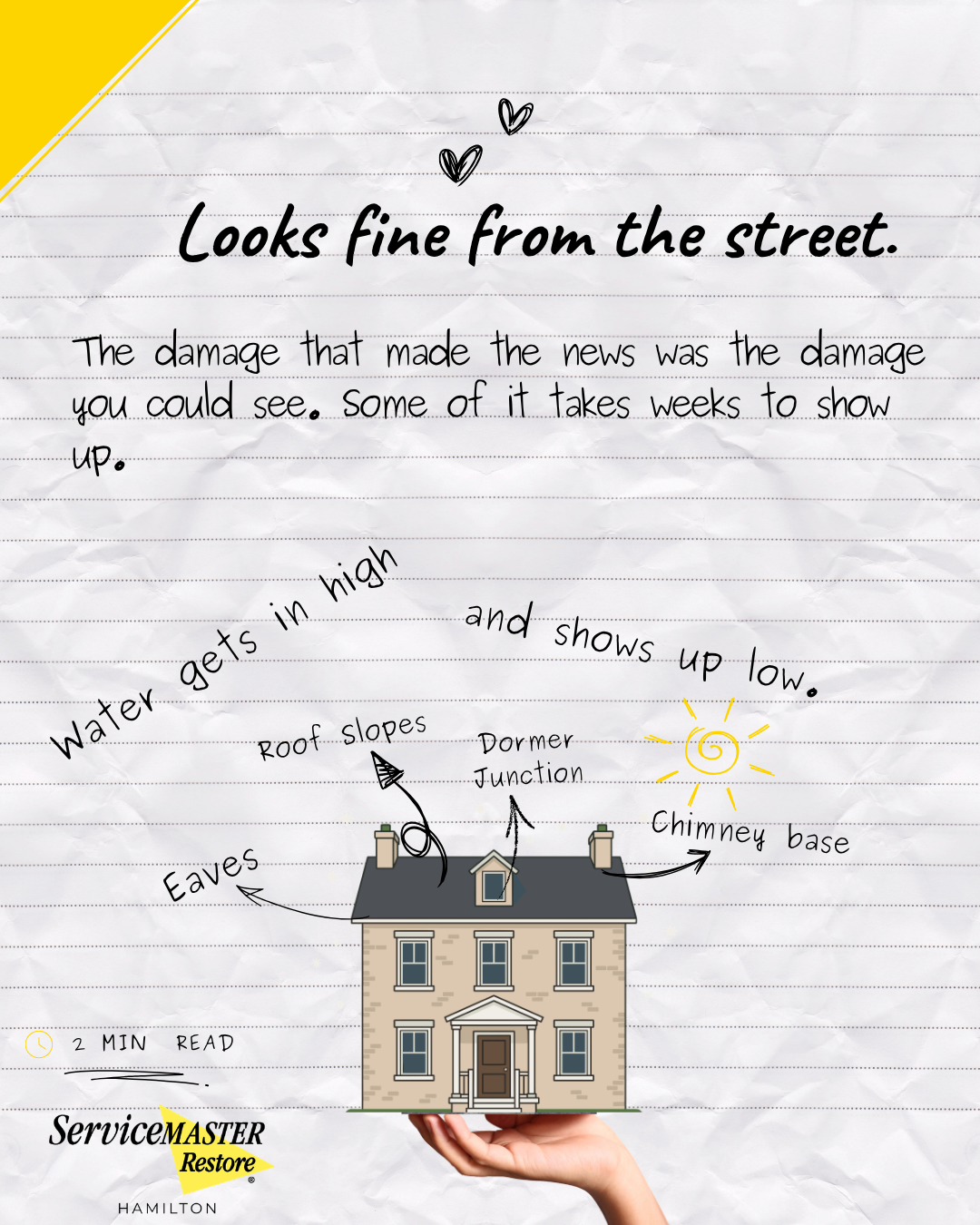
When the September 2 storm tore through Hamilton, the damage that made the news was the damage you could see. CHCH reported downed trees, crushed vehicles, power lines on the ground and stripped siding across the city.
That last one is worth staying with, because siding does not come off cleanly. When wind pulls at a wall, it opens gaps and lifts edges, working water into places the wall was built to keep dry. The same is true of a lifted shingle or a piece of flashing that shifted a few millimetres.
By now the branches are cleared and the hydro is back. From the street, most of those houses look fine.
Why a wall can stay wet
In a strong wind event, rain is not just falling. It can be driven sideways into openings it would normally pass by. An opening that might not cause a problem in a normal rain can behave very differently when wind is driving water against it.
Once water gets into a wall assembly, drying is not always straightforward. Insulation, sheathing and other materials can retain moisture, while some of the layers designed to control moisture movement can also slow the way an assembly dries. Depending on how the wall is built, damp materials can remain hidden long after the exterior looks normal.
That is the gap between when damage happens and when anyone notices it.
What to look for now
This is a good time to take another look. Health Canada advises inspecting for stains, discolouration and musty odours, and notes that mould is not always visible and can grow inside walls. Walk the inside of any exterior wall that took the brunt of the storm and look for:
Staining or discolouration, particularly near the ceiling line, around windows, or at the top of a wall.
Paint or drywall that has changed shape. Bubbling, a seam that has opened, tape lifting at a joint.
A musty smell in one room that is not there in the rest of the house. It is easy to dismiss.
Materials that feel unusually soft or swollen, particularly baseboards, drywall or window sills.
Then go outside and look up. Missing or lifted shingles, siding that no longer sits flush, a soffit hanging slightly low, gaps around vents or flashing. If you can see daylight where you should not, that ought to be treated as a potential water-entry point.
Two practical notes
Photograph anything you find, and photograph the exterior damage too, before repairs. IBC's claims guidance recommends detailed notes and photos when documenting a home insurance claim. That record can help show how the exterior damage and anything you find inside may be connected.
Report it even if it seems minor. IBC advises reporting property damage to your insurance representative with complete and accurate details as soon as possible. Your policy may also contain time limits for parts of the claims process.
The reason to check now is straightforward. If water got into a wall on September 2 and the assembly has not been able to dry properly, it may still be there.
Finding it now gives you a chance to deal with it now. Finding it at Christmas, when the heat is on and a musty smell finally reaches someone, can be a much bigger conversation.
Hamilton Restoration Insights
What’s happening in our city, through a restoration lens.
A weekly series from ServiceMaster Restore of Hamilton.