
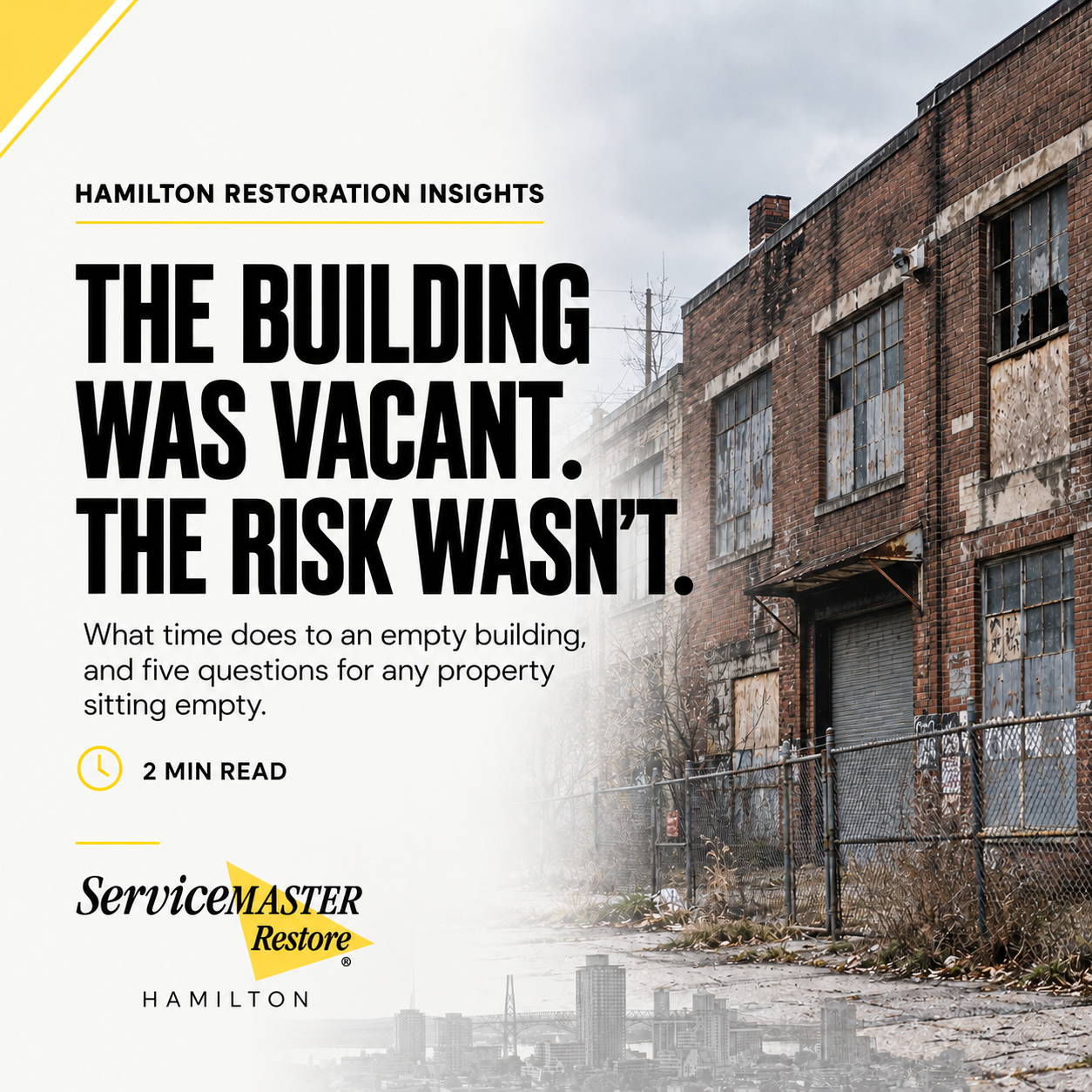
On Sunday, Hamilton firefighters were called to Sherman Avenue North near Biggar Avenue after reports of a rubbish fire.
What they found was more complicated.
Heavy black smoke was coming from a large vacant industrial building. Crews reported several active fires in and around the property, and two nearby dumpster fires also had to be extinguished. Hamilton Police are now investigating the incidents as suspicious.
No financial loss was reported. This time.
Because an empty building may have fewer contents inside, but that does not necessarily mean there is less to worry about.
Vacant does not mean unattended
When a building is occupied, there are usually people around to notice when something changes.
A strange smell.
Water where it should not be.
A broken window.
Someone entering who should not be there.
Smoke.
Once a property sits empty, those ordinary warning systems disappear.
That is one reason Ontario’s Fire Code specifically requires vacant buildings to be secured against unauthorized entry.
Hamilton also has its own Vacant Building Registry. A building that has been unoccupied for more than 90 consecutive days generally needs to be registered, and yearly registration initiates four exterior building inspections.
The point is simple: vacancy changes how a property needs to be managed.
It can also change how a property is insured. What that means for a specific building is a question for the owner’s broker or insurer, and one worth asking before anything happens.
What we can speak to is what happens to the building itself.
What time does in an empty building
In an occupied building, a leaking pipe usually gets noticed quickly. In an empty one, it may have much more time to run before anyone sees it.
By the time someone walks in, water may have travelled into walls, under flooring or through to ceilings below. Health Canada notes that mould can begin growing in areas with excessive moisture within 48 hours, so a slow leak nobody sees can turn into a much bigger problem.
Cold weather adds another risk. A vacant building with unheated or poorly protected areas can be more vulnerable to frozen pipes, especially as temperatures drop.
Fire brings a similar problem. With fewer people around, smoke or fire may have more time to develop before someone notices. Smoke and soot can also move through a building and settle on surfaces well beyond the area that actually burned.
And once a fire is out, the building may be less secure than before. Broken windows and forced doors can let in weather and make unauthorized entry easier.
An empty building still needs a plan
For property managers and owners, vacancy can sometimes feel like a pause.
The tenant has left. Renovations have not started. Redevelopment is still months away.
But the building itself has not paused.
A few practical questions go a long way:
- Who checks the building, and how often?
- Is the heat on, or has the water been shut off and the lines drained?
- Are doors, windows and other openings secured?
- Do fire and police services have a current contact for the property?
- Is there a record of the building’s condition when it became vacant, so changes are easy to spot?
Because fewer people are around to notice problems early, small ones have more time to become large ones.
Sunday’s Sherman Avenue fire is a useful reminder of that.
The building may have been vacant.
The responsibility for protecting it wasn’t.
Hamilton Restoration Insights
What’s happening in our city, through a restoration lens.
A weekly series from ServiceMaster Restore of Hamilton.