
When we think about flooding, we almost instinctively think about rain. But what happens when the wind is moving the water?
Last week, in Hamilton Is Planning for the Water Before It Arrives, we looked at the Lake Ontario Coastal Resilience Pilot Project and the work being done to prepare shoreline communities for flooding, erosion and changing lake conditions.
Less than a week later, we have a timely example of why that work matters.
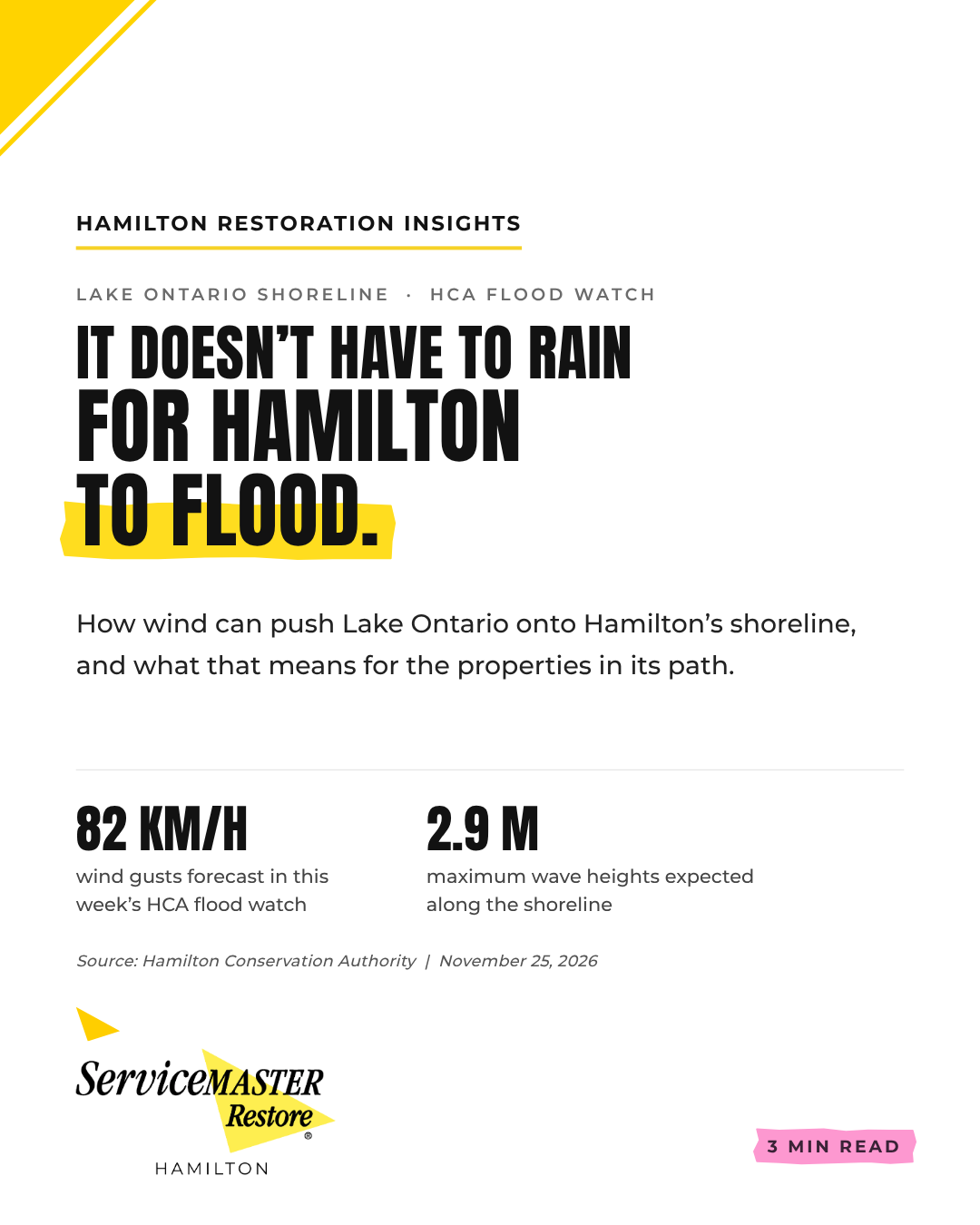
Yesterday, November 25, the Hamilton Conservation Authority (HCA) issued a flood watch for the Lake Ontario shoreline, with sustained northeasterly winds of up to 46 km/h, gusts of up to 82 km/h and waves potentially reaching 2.9 metres.
The concern is localized flooding and shoreline erosion caused by a combination of storm surge and wave action.
How does wind cause flooding?
One of the interesting things about living near the Great Lakes is that water levels can change significantly over a relatively short period without a substantial amount of new water entering the lake.
When strong winds blow persistently in one direction, they push water towards the shoreline, temporarily raising water levels in that area. This is known as wind setup and is a mechanism behind storm surges.
Hamilton's geographical position matters here. Sitting at the western end of Lake Ontario, its shoreline can be particularly exposed when strong northeasterly winds push water towards it.
According to the Canadian Hydrographic Service, storm surges tend to be greatest at the ends of elongated lakes. While surges on deeper lakes such as Lake Ontario rarely exceed half a metre, waves travelling on top of that elevated water level can extend the reach of flooding and contribute to shoreline erosion.
These short-term water level fluctuations can last anywhere from less than an hour to several days.
Essentially, the amount of water in the lake does not need to change significantly for the flood risk along parts of its shoreline to change.
A property can be prepared for one type of flooding and still be vulnerable to another
A sump pump is designed to manage water accumulating around a building's foundation, while a backwater valve helps prevent sewage from flowing back into a property.
Both are valuable flood protection measures, but neither is specifically designed to stop lake water from travelling across the ground and entering through a doorway, basement window or other opening.
Understanding the type of flooding a property is exposed to is just as important as having measures in place to protect it. This also helps explain why the coastal resilience project we explored last week is considering different approaches for different shoreline communities.
Where the water comes from matters
From a restoration standpoint, water entering a property from a lake presents a different set of considerations from water escaping a supply pipe inside the building.
As floodwater travels across the ground, it can carry sediment, organic matter and other contaminants into the property. This has implications for how affected materials are assessed, cleaned and, in some cases, removed.
The Institute of Inspection, Cleaning and Restoration Certification (IICRC), in its February 2026 position statement on weather-related water damage, reinforces the importance of assessing the actual conditions of a loss when determining the category of water contamination.
Floodwater entering a building from a lake can be grossly contaminated and may require Category 3 remediation under the ANSI/IICRC S500 standard. The source of the water, what it has come into contact with and the conditions found during inspection all inform the appropriate restoration approach.
Two properties with the same depth of water may therefore require very different restoration scopes.
There is an insurance consideration here too.
The Insurance Bureau of Canada (IBC) identifies the overflow of lakes as one of the risks typically addressed by optional flood coverage. However, IBC also notes that home and business insurance policies generally do not cover damage caused by coastal flooding and/or storm surge.
For properties along Hamilton's shoreline, this is an important distinction. How wind-driven lake flooding is treated under a particular policy will depend on its definitions, exclusions and endorsements.
For property owners and the insurance professionals who advise them, it is a distinction worth understanding before a loss occurs.
From long-term planning to today's reality
Last week, we explored how Hamilton is preparing for changing shoreline conditions over the years ahead. Today's flood watch reminds us that those conditions can also change within a matter of hours.
The HCA advisory is scheduled to remain in effect until Friday, November 27, at 4:30 p.m. Residents are encouraged to monitor the HCA's water level status page for updates and to stay away from lakefront areas during this period.
If there is one thing worth taking away from our conversations over the last two weeks, it is that flood preparedness begins with understanding the nature of the risk.
Knowing that your property is vulnerable to water damage is one thing. Understanding how that water could reach your property, whether your existing protection measures can manage it and whether your insurance responds to it is another.
Hamilton Restoration Insights
What’s happening in our city, through a restoration lens.
A weekly series from ServiceMaster Restore of Hamilton.