
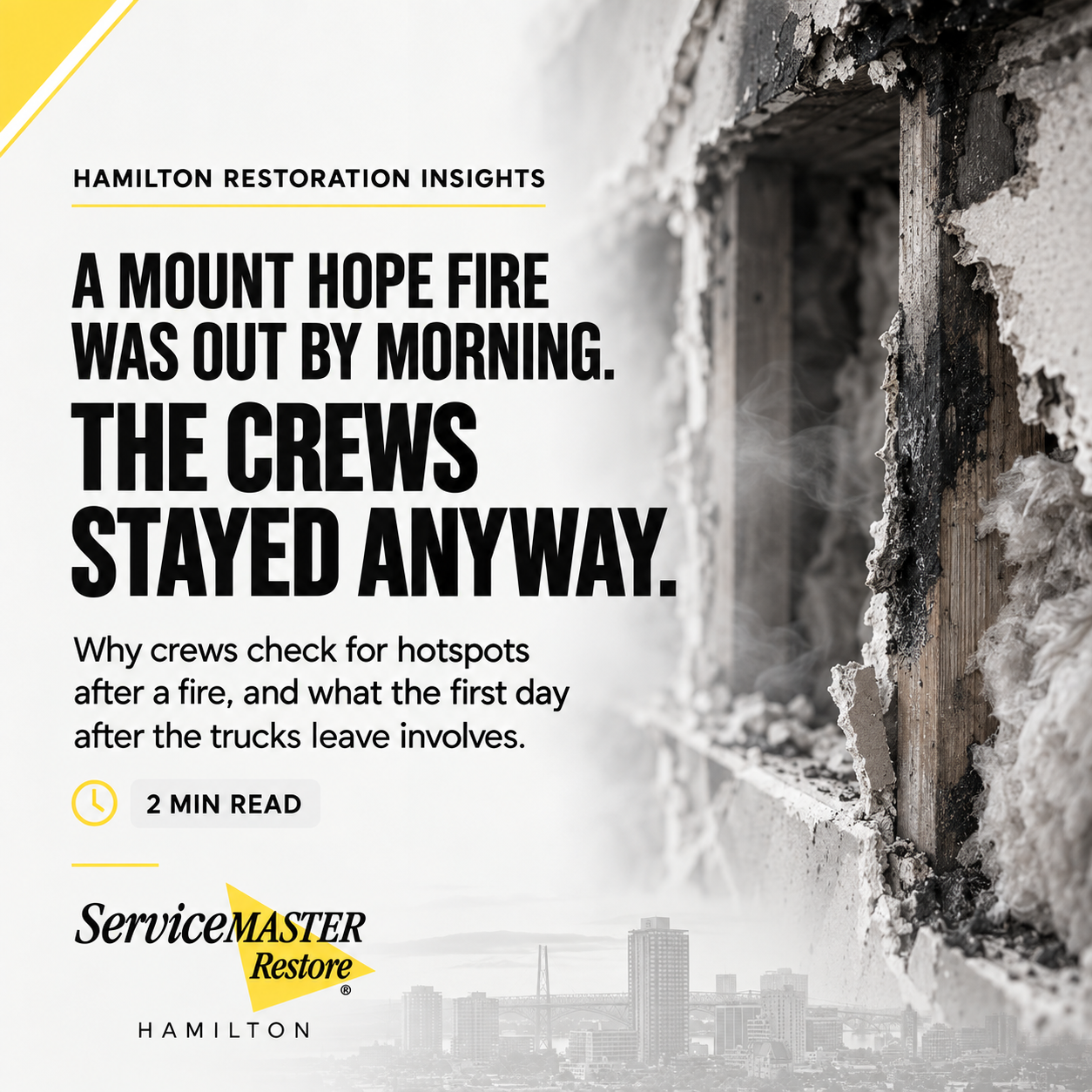
Emergency crews were called to a large structure fire on Glancaster Road in Mount Hope on Wednesday morning, at around 5:26 a.m.
According to CHCH News’ report on the Mount Hope fire, the fire was extinguished. No injuries were reported, and the cause had not been released.
But one detail in the coverage is worth pausing on.
After the fire was out, crews stayed on scene checking for hotspots.
That is standard fire-service work, but it also helps clarify a common misconception about what happens after a structure fire:
Once the flames are out, the emergency is not necessarily over.
A fire that looks out may not be finished
Wall cavities, ceilings, attic spaces, soffits and insulation can hold heat or smouldering material after the visible flames have been extinguished.
Ontario’s firefighter guidance on salvage and overhaul describes this post-extinguishment work as including the search for hidden sources of fire.
That is why firefighters may need to open sections of walls or ceilings and continue checking the building after the fire appears to be over.
They are making sure there is no hidden fire left behind.
But once that work is complete, the building can still be dealing with the effects of everything that just happened.
What the building is left with
Parts of the structure may have been opened to reach concealed fire or heat, leaving the property vulnerable to weather or unauthorized entry.
Then there is the water.
Depending on the fire, water used during suppression can move through flooring, ceilings and wall assemblies into areas the flames never reached. If wet materials remain untreated, moisture can create a different set of problems in the days that follow.
Health Canada advises that wet materials should be dried quickly, noting that mould can begin developing under excessive-moisture conditions within about 48 hours.
Smoke can travel even farther.
Smoke and soot may affect rooms, contents and surfaces well beyond the visibly burned area. The Canadian Conservation Institute notes that items located away from the seat of a fire, including those in other rooms, can still be affected by heat, smoke and soot.
So the area requiring assessment after a fire can be much larger than the area where flames were visible.
The first day matters
The work immediately following a fire is usually not reconstruction.
It is stabilization.
That can mean securing openings, addressing wet materials, identifying unsafe areas, protecting contents and documenting the condition of the property before mitigation significantly changes the scene.
Photographs, notes and inventories created early can help establish what was damaged, where the damage occurred and what condition the property and contents were in before materials were removed, cleaned or altered.
For owners, property managers and insurers, that early record can become an important part of understanding the loss that follows.
The takeaway
The moment the flames disappear can feel like the end of the emergency.
It usually marks the beginning of a different phase.
When crews stay behind to check for hotspots, they are finishing one job.
The building still has another one waiting.
Hamilton Restoration Insights
What’s happening in our city, through a restoration lens.
A weekly series from ServiceMaster Restore of Hamilton.