
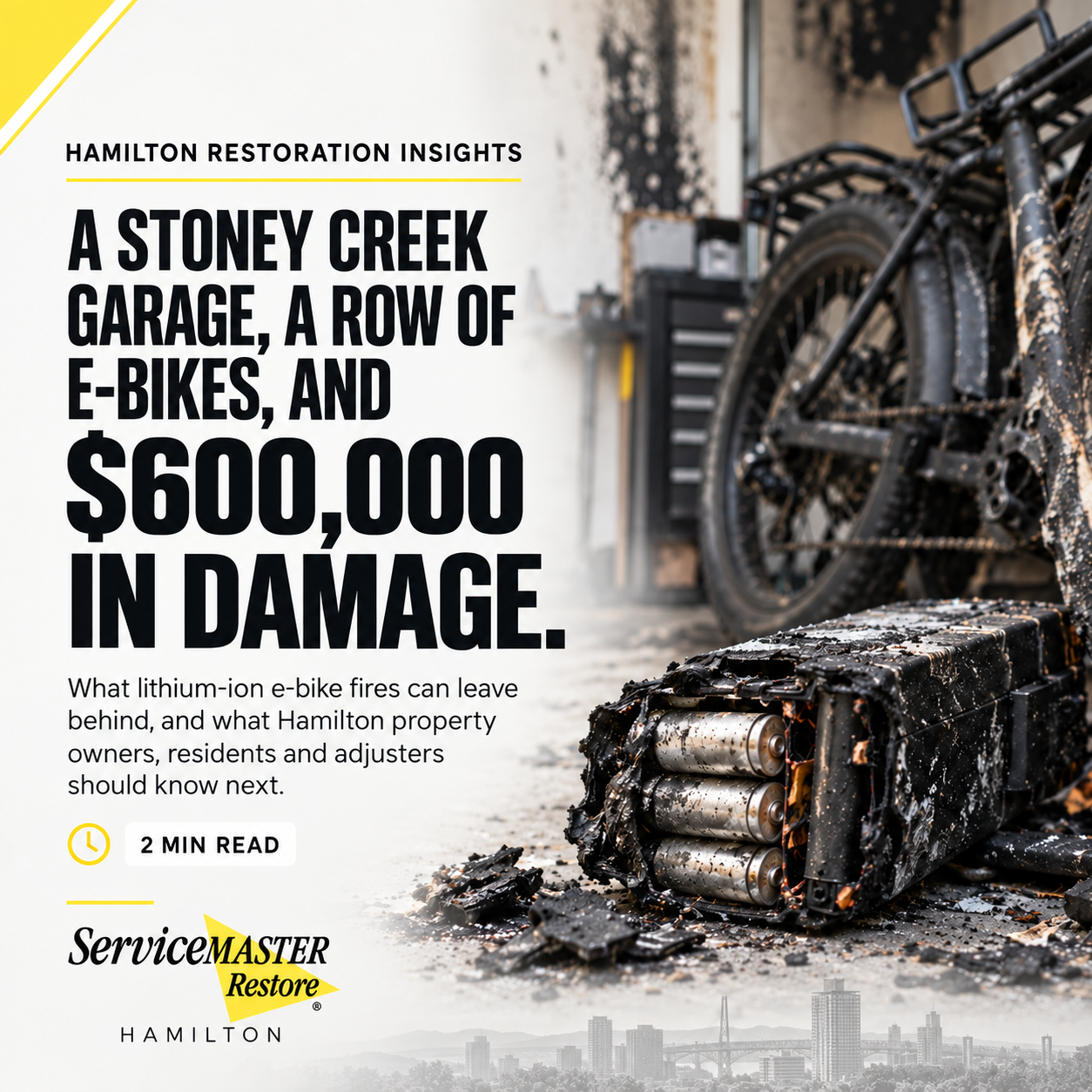
On the morning of Friday, September 11, Hamilton firefighters were called to a two-storey home in Upper Stoney Creek. The first crews found the garage fully engulfed, with heavy fire and smoke moving up the front of the house toward the home next door. They had the garage fire under control in about 15 minutes, but by then the space was already gutted.
So, what caused the fire? Hamilton Fire says lithium batteries are the suspected cause. Several e-bikes and a large quantity of lithium-ion batteries were in the garage when the fire started.
Thankfully, everyone got out safely, though the family has had to move into alternative accommodation.
Why lithium fires move so fast
Crews had the fire under control in 15 minutes, which is quick work. But lithium-ion batteries can behave differently from many other things that burn in a home.
Lithium-ion batteries can fail through a process called thermal runaway. Health Canada describes this as excessive heat building inside a battery because of damage, malfunction or misuse. In larger battery systems such as e-bikes, incidents can be more severe and the resulting fires harder to extinguish.
Now picture that in an enclosed garage space with several e-bikes and spare batteries stored close together.
Walk into your own garage
For many Hamilton families, the garage has become the charging station. E-bikes, scooters, power tool packs and lawn equipment batteries all tend to end up there.
And in many homes, the garage shares a wall, an attic space or a door with the house.
That makes where and how they are charged worth thinking about. Health Canada recommends charging lithium-ion batteries at room temperature where you can see them, away from soft surfaces that can trap heat, and away from exit doors in case of fire.
In Stoney Creek, crews entered the home through heavy smoke while the garage was still burning.
The flames were stopped at the garage. The smoke didn't stop there.
When the fire is out, the job changes
A battery fire can also change the questions asked during restoration.
What burned? Where did the smoke travel? Which rooms and contents were exposed? Are damaged batteries or battery components still present? What needs specialist assessment before cleanup begins?
This is where the source of a fire matters. As we touched on in our earlier Hamilton Restoration Insights soot article, smoke residue is not simply black dirt. What burned influences what is left behind and how the affected property needs to be assessed. Smoke and soot can move beyond the area touched by flames and affect walls, ceilings, furniture and contents elsewhere in a property.
The Canadian Red Cross also notes that household items exposed to smoke, soot and fire damage can require repeated cleaning, while some affected contents may need to be discarded.
For adjusters, that can mean the visible burn area is only part of the loss being assessed. Smoke movement, affected contents and the materials involved can all influence how the scope develops.
It is also why these claims can grow larger than the burned area suggests.
Take five minutes and check your charging setup
- Keep batteries away from exit doors and things that can burn easily. Health Canada specifically recommends charging away from exit doors and soft surfaces that can trap heat.
- Charge where you can see the device rather than leaving it unattended for long periods.
- Use the charger that came with the device or an appropriate certified replacement. Health Canada recommends using the original charger and, when replacing one, ensuring it is compatible and carries a recognized Canadian certification mark.
- Stop using batteries that are swollen, damaged or otherwise showing signs of wear, and check with your municipality for safe disposal instructions.
The takeaway
The question isn't whether you own lithium batteries, because almost everyone does.
The question is where they sit while they charge, and what's on the other side of that wall.
Hamilton Restoration Insights
What’s happening in our city, through a restoration lens.
A weekly series from ServiceMaster Restore of Hamilton.